UNEARTHING THE PAST SINCE 1900
  • BECOME A MEMBER
  • RENEW
  • GIVE NOW
  • SEARCH
  • ONLINE PORTAL
  • American Society of Overseas Research (ASOR)American Society of Overseas Research (ASOR)
  • ABOUT
    • WELCOME FROM ASOR OFFICERS
    • HISTORY OF ASOR
    • MISSION, BYLAWS, & STRATEGIC PLAN
    • Board of Trustees
    • COMMITTEES
    • POLICIES
    • FINANCIAL DOCUMENTS
    • MEDIA RELEASES
    • CONTACT US
  • CULTURAL
    HERITAGE
    • ABOUT CULTURAL HERITAGE INITIATIVES
    • UPDATES
    • PAST GRANTS
    • TUTORIALS
    • Who We Are
  • ANNUAL
    MEETING
    • REGISTRATION
    • HOTEL RESERVATIONS
    • ANNUAL MEETING SCHEDULES
    • SPONSOR & EXHIBIT
    • ASOR Online Library
    • HONORS & AWARDS
    • ANNUAL MEETING SCHOLARSHIPS
    • PAST & FUTURE ANNUAL MEETINGS
  • MEMBERSHIP
    & RESOURCES
    • INDIVIDUAL MEMBERSHIPS
    • INSTITUTIONAL MEMBERSHIPS
    • NEWS@ASOR
    • PAST ASOR NEWS, MONTH BY MONTH
    • AFFILIATED PROJECTS
    • AFFILIATED RESEARCH CENTERS
    • ARCHIVES
    • ONLINE RESOURCES
      • PHOTO COLLECTION
    • EARLY CAREER MEMBER RESOURCES
  • FELLOWSHIPS
    & GRANTS
    • SCHOLARSHIPS FOR FIELDWORK PARTICIPATION
    • GRANTS FOR ARCHAEOLOGICAL PROJECTS
    • RESEARCH FELLOWSHIPS FOR MEMBERS
    • MEMBERSHIP & ANNUAL MEETING SCHOLARSHIPS
    • ASOR-AFFILIATED RESEARCH CENTERS FELLOWSHIPS
    • OTHER FELLOWSHIP PROGRAMS
  • PUBLICATIONS
    • BOOK SERIES & MONOGRAPHS
    • BULLETIN OF ASOR
    • JOURNAL OF CUNEIFORM STUDIES
    • MAARAV
    • NEAR EASTERN ARCHAEOLOGY
    • THE ANCIENT NEAR EAST TODAY
    • News@ASOR
    • LEVANTINE CERAMICS PROJECT
  • FRIENDS
    OF ASOR
    • Webinars
    • TOURS
    • THE ANCIENT NEAR EAST TODAY
    • ASOR ONLINE LIBRARY
  • Donate
    • FY25 HONOR ROLL OF DONORS
    • LIFETIME HONOR ROLL OF DONORS
    • ASOR LEGACY CIRCLE
    • WAYS TO DONATE
BDCHq7Jg

 SHARE


NEWS@ASOR E-NEWSLETTER

ANCIENT NEAR EAST TODAY E-NEWSLETTER

PAST ASOR NEWS, MONTH BY MONTH

ASOR LEGACY CIRCLE MEMBERS

LIFETIME HONOR ROLL OF DONORS

FY25 HONOR ROLL OF DONORS

ASOR ANNUAL MEETING

Living it up in the Archaeology Lab

Claire Hook, 2024 Katherine Barton Platt Fellowship Recipient

While working on the Brač Island Project on a beautiful island in Croatia, the team got to excavate our hillfort site, Gradina Rat. At the same time, we were learning about what was being excavated during the project because of our work in the lab to identify and document the artifacts being uncovered.

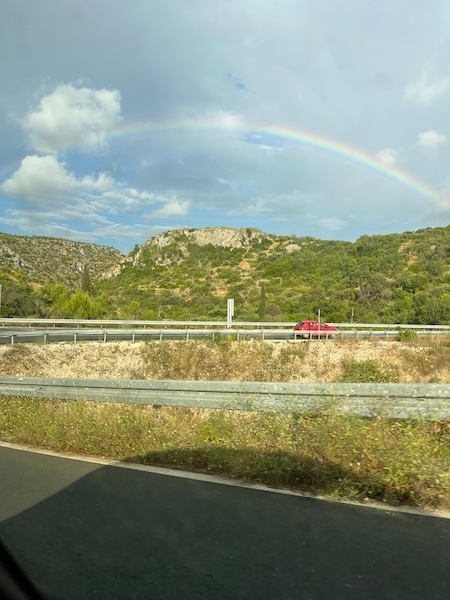
Our last drive to site featuring a rainbow perfectly over Gradina Rat where we were excavating.

Although a large part of archaeology is the excavation, understanding what was happening in the past at a site comes from identifying and analyzing the artifacts and doing additional research in the lab. My role this season was the lab assistant, so I was able to spend some days out on site, but a majority of my time was spent helping Dr. Sarah James in the lab working directly with the ceramic assemblage

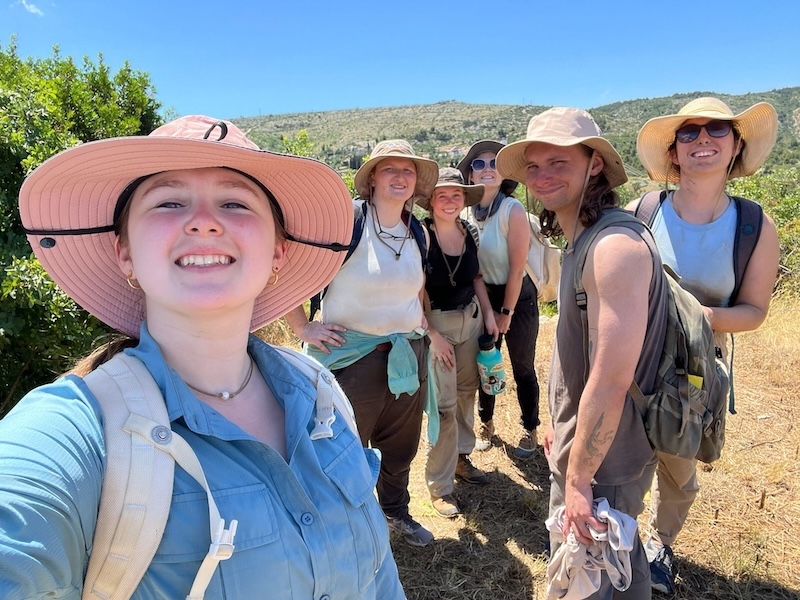
The excavation crew at site after our morning excavations. I am on the far right.

There were four main tasks that I helped to complete throughout the season to
keep everything running smoothly and figure out what was happening within each context of finds.

The first part of the lab work was pottery washing.

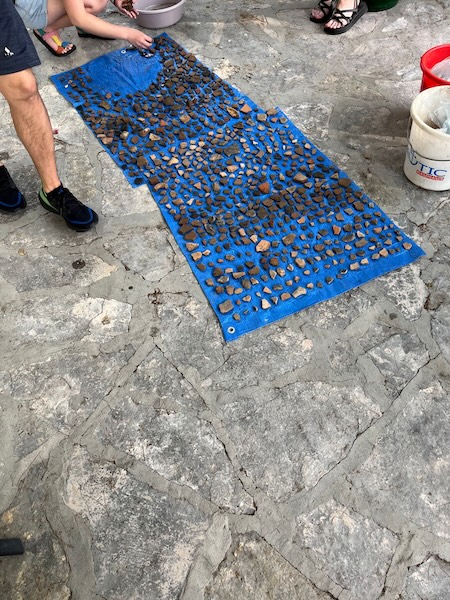
The ceramic assemblage from one context all laid out to dry after being washed.

Everyone who participated in the project helped with washing the ceramic finds so that any designs and colors could be more easily seen once the dirt was scrubbed away and so the artifacts remained clean. We washed the pottery that was brought down from the site every day—unless it was raining so badly that we couldn’t be outside—so that we could keep up with all the finds that were excavated.

The next step in lab work was artifact reading where we would record as much precursory information about the artifacts as possible. We recorded each artifact into the database alongside their context numbers to give a sense for the assemblage throughout the contexts. For the ceramic sherds, the team would partner with Dr. James and Dr. Barbarič to record the identifiable sherds from each context and give them a preliminary vessel shape and date range. I would also take counts and weights of the three main categories of ceramic vessels: table, cooking, and coarse ware. Knowing the types of ceramics being used on site was helpful for recognizing that this was not a domestic settlement and that something far more interesting was happening at this site.

After the ceramic pieces were read into the database, the pieces that required more research to identify or that could give new information about the assemblage were catalogued. A lot of my time in the lab was spent cataloguing pottery sherds. One goal we achieved for this season was to finish cataloguing the artifacts discovered in previous seasons and to work through as many sherds from this season as possible. Cataloguing included taking the dimension and weight of each sherd and describing the texture of the surface, the strength of the firing technique, the interior color and inclusions of the clay (also known as the fabric of a vessel), and any exterior decorations. After detailing the specific piece, I would research comparable shapes and decorations from other authors to help verify the classification of the shape, origins, and date of the original vessel. With this information, we were able to get a clearer sense of the activities and uses of the ceramics at Gradina Rat and how the people living on Brač were connecting with traders from other countries.

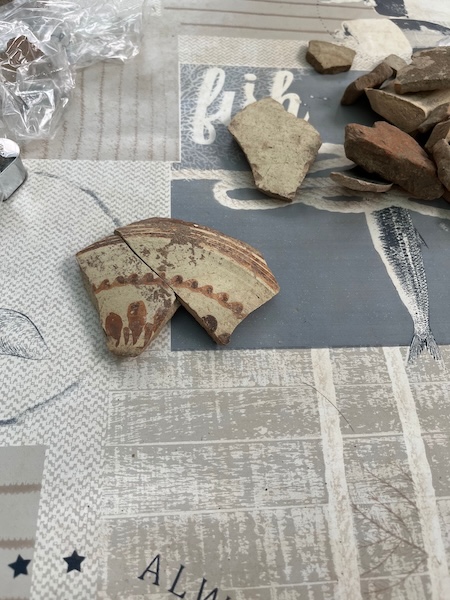
Two joining sherds of Italian Matt Painted Imported Ware from the 4th to 6th c. BCE.

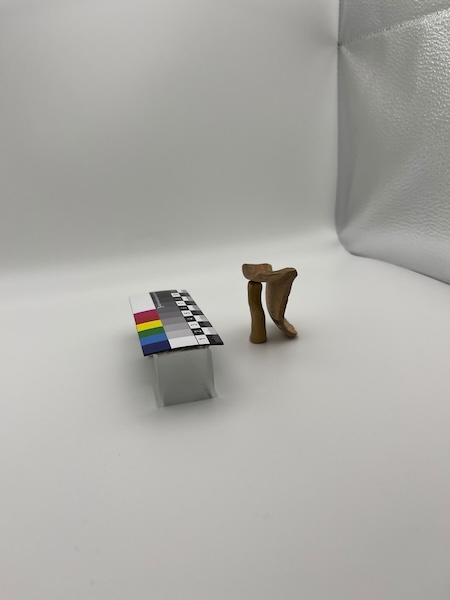
The last piece of lab work was photographing some of the especially important finds to have clear photos of special artifacts, the ranges of imported vessels, and the common local vessels. Having these photos will allow other scholars to work with the artifacts found at this site and will aid in visually accompanying any research written about this site. Our set up was simple yet effective. I only occasionally had to carefully hide clay supports to help get certain angles of the pieces.

Lab work in action to photograph one of the ceramic sherds.

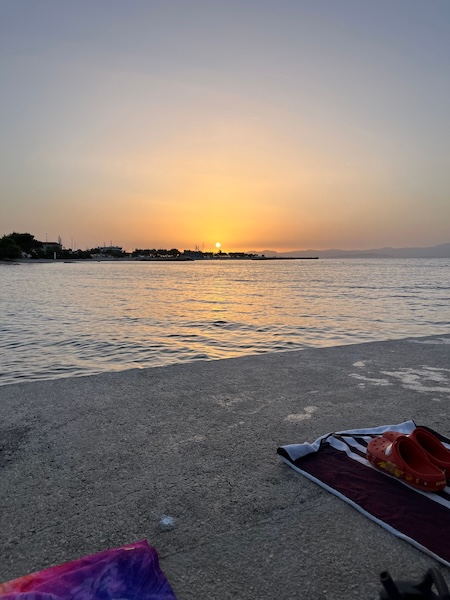
At the very end of the day, we would all gather down at the beach to watch the sunset after everyone finished their afternoon tasks, and sometimes we’d jump into the magical waters of the Adriatic and theorize about what exactly the ancient people were doing up on that hill.

Swimming at sunset after a hard day’s work in the field and in the lab.

Claire Hook just graduated with a Masters of Classical Art and Archaeology from the University of Colorado Boulder. Her research interests are in the responses and treatment of child mortality in Ancient Greece, and the ceramic assemblages that accompany them. 

ASOR is now accepting applications for 2025 Fieldwork Participation Scholarships. Learn how to apply here. 

Want to help more students and early career archaeologists get into the field? Donate to the cause today by selecting “Fieldwork Scholarships” as your gift purpose!
Recent Posts

  • Fieldwork Report: Anna Taibi
  • Fieldwork Report: Hannah Borotsik
  • AM25 Recordings Now Available on ASOR’s Online Library
  • FOA Webinar: Carl Walsh
  • Call for Early Career Scholars Committee Members

Latest Posts from @ASORResearch

asor_research

Initiating and supporting research of the history and cultures of the Near East and wider Mediterranean world.


ASOR invites members to submit paper abstracts and
ASOR invites members to submit paper abstracts and workshop presentation proposals for the 2026 Annual Meeting taking place November 18-21 in Chicago and online. Abstracts of 250 words or less may be submitted between now and March 15. Read more in the Call for Papers: https://www.asor.org/am/2026/call-for-papers-2026


Hannah Borotsik, a 2025 P. E. MacAllister Fellowsh
Hannah Borotsik, a 2025 P. E. MacAllister Fellowship recipient, returned to the Athenian Agora excavations in Greece for her third season last summer. A PhD student at the University of Western Ontario, Hannah served as apotheke supervisor managing the processing of finds and training volunteers. Read her report, "Just a Girl and Her Whiteboard," here: https://www.asor.org/news/2026/02/fieldwork-report-borotsik
#Archaeology #Greece #Athens


ASOR is accepting applications for two 2026 Study
ASOR is accepting applications for two 2026 Study of Collections Fellowships of $2,000 each. These fellowships are intended to support the study of collections including museum and archival collections, repositories, or collections of national authorities. Applications are due February 23, 2026. Learn more by clicking the link (https://www.asor.org/fellowships/study-of-collections-fellowships/) in our bio.


The Early Career Scholars (ECS) Committee is looki
The Early Career Scholars (ECS) Committee is looking for new members. We especially seek those interested in supporting ASOR’s Early Career (undergraduate to pre-tenure) community through creative, informal mentoring opportunities. Learn more by clicking the link (https://www.asor.org/news/2026/01/early-career-scholars-call) in our bio.


Join us for the next FOA webinar on Wednesday, Feb
Join us for the next FOA webinar on Wednesday, February 18th at 7:00pm ET: "'An elegance of spirit adorns all its works.': Auguste Rodin and the Art of Ancient Egypt," presented by Dr. Carl Walsh. Most people would not conceive of any connection between the works of the master French sculptor Auguste Rodin (1840–1917) and the art of ancient Egypt. In this talk, Dr. Walsh will discuss how Rodin became interested in ancient Egyptian art in his waning years and the profound—if subtle—impact it had on the sculptor’s practice through the objects in the current exhibition Rodin’s Egypt, now on display at the Institute for the Study of the Ancient World at New York University. Click the link (https://www.asor.org/news/2026/01/webinar-walsh ) in our bio to read more and register.


If you are in the greater Washington D.C. area, yo
If you are in the greater Washington D.C. area, you are welcome to join this special lecture by Dr. Ahmad Emrage at George Washington University on Tuesday, February 10 from 5:30–6:30 PM. Dr. Emrage, a member of the Libyan Department of Antiquities and an ASOR member, will be discussing the cultural heritage of Libya.


ASOR is supporting archaeological fieldwork for ou
ASOR is supporting archaeological fieldwork for our members in 2026 by offering Project Grants (for directors) and Scholarships for Fieldwork Participation (for students and volunteers). Both grants and scholarships are for work on ASOR-affiliated projects. The application deadline for both is Monday, February 23. Learn more by clicking the link (https://www.asor.org/fellowships/) in our bio.


Our #ObjectoftheWeek: A series of grave goods from
Our #ObjectoftheWeek: A series of grave goods from a cemetery in Kedurma, Sudan, dated to the Meroitic period. ca. 3rd cent. BCE–4th cent. CE. Photo credit: Mohamed Bashir, CC by-SA 4.0.
#Archaeology #Nubia #Kush #Sudan


Narrative accounts of genocidal violence appear mu
Narrative accounts of genocidal violence appear multiple times in the Hebrew Bible. Why are they there and what do they have to do with modern genocides? Read the newest ANE Today by T. M. Lemos by clicking the link (https://anetoday.org/genocide-hebrew-bible/) in our bio.


ASOR is pleased to announce that recordings from t
ASOR is pleased to announce that recordings from the 2025 Annual Meeting in Boston are now available to view on the 2025 ASOR Online Schedule and ASOR’s Online Library. This initiative not only helps preserve the wealth of knowledge shared but also ensures that those who couldn’t attend the event in person still have access to session and workshop presentations (nearly 500 in total). Learn how to access the recordings by clicking the link (https://www.asor.org/news/2026/02/am25-recordings) in our bio.


Don't forget to tune in TOMORROW at 12:30 pm ET fo
Don't forget to tune in TOMORROW at 12:30 pm ET for the next FOA webinar presented by Benyamin Storchan: "Unearthing an Imperially Glorious Byzantine Church near Bet Shemesh: From Fieldwork to Virtual Reality". If you haven't already signed up, click here to register for free: https://www.asor.org/news/2026/01/webinar-storchan


Registration is now open for the Friends of ASOR t
Registration is now open for the Friends of ASOR two-day Philadelphia Tour on April 16–17! Join us for exclusive, behind-the-scenes access at the Penn Museum, the Barnes Foundation, and the Philadelphia Art Museum, featuring expert-led tours, special lectures, and insights into archaeology, art, and conservation. Learn more and register here: https://www.asor.org/news/2026/01/tour-philadelphia-2026


The Levantine Ceramics Project (LCP) is partnering
The Levantine Ceramics Project (LCP) is partnering with @pennmuseum for a "Data Day" as part of their Museum Workshop Program. Join them for a day of ancient pottery and data entry (and free food)! Register your interest by January 30th: https://docs.google.com/forms/d/e/1FAIpQLSdws1Ml2Ku-X7Yg-vBUoy6AZv54zRqvvLgdrIJaPsL5H688Ow/viewform


At Tall Hisban in Jordan, the Lawrence T. Geraty C
At Tall Hisban in Jordan, the Lawrence T. Geraty Community Archaeology Endowment has supported educational opportunities, heritage events, and community engagement. In 2025, the Geraty Endowment helped make possible the Hisban Heritage Festival, student-led community history projects, and the Madaba Region Heritage Internship. Read more in this grant report: https://www.asor.org/news/2026/01/geraty-grant-report
#Jordan #Madaba #Heritage


ASOR’s room block at the Hilton Chicago for the 20
ASOR’s room block at the Hilton Chicago for the 2026 Annual Meeting is now open. Registered Annual Meeting attendees can reserve a room at the discounted rate of $159 (plus tax) at this iconic downtown hotel overlooking Grant Park and Lake Michigan. To make your reservations, click here: https://www.asor.org/am/2026/hotel-city-2026


Join us for the next FOA webinar on Wednesday, Feb
Join us for the next FOA webinar on Wednesday, February 4th at 12:30pm ET: "Unearthing an Imperially Glorious Byzantine Church near Bet Shemesh: From Fieldwork to Virtual Reality," presented by Benyamin Storchan. In the heart of the Holy Land, just 15 miles southwest of Jerusalem, lies one of the most remarkable Byzantine churches discovered in recent decades. The archaeological excavations at the Church of the Glorious Martyr unearthed a fascinating five-century story of faith and pilgrimage, yet the greatest mystery remains unsolved: who was the Glorious Martyr venerated in the sacred crypt? Read more and register here: https://www.asor.org/news/2026/01/webinar-storchan


Call for papers: The William F. Albright Institute
Call for papers: The William F. Albright Institute of Archaeological Research announces the 25th Annual Sean W. Dever Memorial Prize. The prize awards $750 for the best conference paper in Syro-Palestinian or Biblical Archaeology.

Eligibility:
• Ph.D. candidates (as of Spring 2026)
• Paper must be in English
• Must be an unpublished/not prepared for publication conference paper

Deadline: February 15, 2026
Winner announced: March 9, 2026
Apply via the Albright Fellowships Portal: https://aiar.org/fellowships


The deadline to apply for ASOR's 2026-27 Mesopotam
The deadline to apply for ASOR's 2026-27 Mesopotamian Fellowships is Monday, January 26! These fellowships are primarily intended to support fieldwork/research on ancient Mesopotamian culture carried out in the Middle East. Apply now: https://www.asor.org/fellowships/mesopotamian-fellowship/


Our #ObjectoftheWeek: A limestone statue of an eag
Our #ObjectoftheWeek: A limestone statue of an eagle wrestling with a serpent found at Khirbet et-Tannur, an ancient Nabataean temple in southern Jordan. ca. 100-200 CE. CAM 1939.222. Photo credit: Cincinnati Art Museum.
#Archaeology #Jordan #Nabataean


Since the Neolithic, mudbrick architecture has bee
Since the Neolithic, mudbrick architecture has been one of the most widespread building traditions across the world. But a mudbrick is more than a structural unit: it is also a repository of information. Read the newest ANE Today by Marta Lorenzon by clicking the link (https://anetoday.org/mudbrick-architecture-meaning/) in our bio.
#Architecture #Mudbrick


Instagram

Stay updated with the latest insights, photos, and news by following us on Instagram!

Follow Us on Instagram

American Society of Overseas Research
The James F. Strange Center
209 Commerce Street
Alexandria, VA 22314

E-mail: info@asor.org

© 2025 ASOR
All rights reserved.
Images licensed under a Creative Commons Attribution-NonCommercial-ShareAlike 4.0 International License

Contact Us
Membership
Give
Friends of ASOR
ASOR Cultural Heritage Initiatives
Terms of Use
News

Please follow & like us :)
Facebook
YouTube
LinkedIn